
Criminal Court Cases in Tattnall County
Tattnall County criminal court cases do not all land in one court. Superior Court hears felonies. State Court handles county misdemeanors and traffic matters. Magistrate Court deals with warrants, first appearances, preliminary functions, and limited misdemeanors. Glennville, Reidsville, and Collins municipal courts keep ordinance, traffic, and related bench-warrant records created at the city level. A citation number from one of those cities should not be assumed to be a Superior or State Court case number.
The Clerk of Superior Court is the practical custodian for Superior, State, and Juvenile Court files. The office is at 111 North Main Street, Reidsville, GA 30453, receives mail at PO Box 39, and answers 912-557-6716. Hours listed by the official GSCCCA clerk directory are Monday through Friday, 8:00 a.m. to 5:00 p.m. Ask the clerk which court owns the file before requesting a docket, copy, or certification.
Tattnall Court Levels by Charge
The first useful question is not merely whether a record exists. It is which court created it. A sheriff booking charge is an allegation at intake, while a prosecutor may later file a different count. Superior Court holds the felony prosecution. State Court holds a county misdemeanor prosecution. Magistrate Court may hold the warrant or early judicial process without owning the final felony file. A municipal court may keep a city citation even when a related arrest produced a county jail record.
| Record or matter | Likely custodian | Best first detail |
|---|---|---|
| Felony prosecution | Tattnall Superior Court clerk | Defendant name and filing year |
| County misdemeanor or traffic case | Tattnall State Court clerk | Case or citation number |
| Warrant or first appearance | Magistrate Court or sheriff | Name and event date |
| City ordinance or citation | Glennville, Reidsville, or Collins court | City citation number |
Tattnall County Case Record Searches
Georgia does not provide one complete free statewide docket search. The Georgia Courts e-access directory routes Tattnall Superior and State Court users to PeachCourt. Its public landing page requires an account. The page advertises civil and criminal e-filing and court documents, but the research did not verify a no-login Tattnall name search or a public sample docket. Use the directory rather than guessing at a vendor, then fall back to the clerk if authentication or coverage gets in the way.
- Identify the likely court from the charge, citation, or warrant.
- Use the Georgia Courts e-access directory to confirm the listed provider.
- At PeachCourt, use the available account controls and search with a case number when possible.
- Read the docket index before asking for each underlying document.
- Call or visit the clerk for older files, copies, certification, or missing results.
PeachCourt does not expose its full Tattnall search form before authentication. That limits any honest field inventory to the identifiers that official clerk practice supports.
| Search detail | Use | Why it helps |
|---|---|---|
| Case number | Best direct key | Points to one docket when entered correctly |
| Defendant name | Fallback key | May return more than one person or case |
| Approximate year | Narrowing detail | Helps the clerk locate older records |
| Date of birth | Identity aid | May distinguish similar names, subject to public-access limits |
| Court level | Routing detail | Separates Superior, State, Magistrate, and city files |
PeachCourt Access in Tattnall County
The PeachCourt account-access page shows why an online search may stop before a Tattnall County docket appears.

The account wall makes the clerk’s phone and counter essential access channels, not mere backups. Give the clerk the exact case number if one is available. Ask for the court, current status, docket or register of actions, disposition, and whether the requested documents are public. A web event line may show that something was filed without exposing the underlying PDF.
For mail or counter requests, name the defendant, court, case number or approximate year, and desired record components. State whether a plain copy or certified copy is needed. Tattnall County does not publish criminal copy or certification prices on the official clerk page, so request the page count and an estimate. Older court case files may need retrieval. The office is not required to create a new criminal-history compilation when no such report exists.
What a Criminal Case File Contains
A Tattnall County criminal case file is a sequence of filings and orders, not one summary sheet. Start with the docket or register of actions. It identifies the events that may lead to an accusation or indictment, bond orders, an arraignment entry, motions, hearing notices, a plea or verdict, judgment, sentence, probation terms, a revocation filing, warrant or capias entries, and closure. Request the judgment or disposition document when a short code is unclear.
| Case number and court | Identifies the filing and the Tattnall County court that owns it. |
|---|---|
| Charging document | Shows the accusation or indictment as filed, which remains an allegation until adjudication. |
| Docket entries | Lists filed events, motions, notices, orders, and hearing activity. |
| Hearing dates | Records scheduled or completed court events, subject to calendar confirmation. |
| Disposition and judgment | States how each filed count ended and supplies the official outcome. |
| Sentence and conditions | Shows custody, probation, financial terms, and other ordered conditions when public. |
Reading Tattnall Case Outcomes
Disposition words must stay precise. An accusation or indictment states an allegation. “Guilty” reflects an adjudication or plea, while “nolo” is a separate plea. “Dismissed,” “nolle prosequi,” and “no bill” describe different ways a charge may end. A dead-docket entry can leave a count dormant. First Offender treatment depends on eligibility and successful discharge. A warrant entry records process, not guilt. A probation revocation filing is only an allegation until the court rules.
- Nolle prosequi
- A prosecutor’s formal decision not to proceed with a charge at that time.
- No bill
- A grand jury decision not to return an indictment on the proposed charge.
- Dead docket
- A dormant status that is not the same as a conviction or ordinary dismissal.
- Certified copy
- A copy the clerk attests matches the filed court record.
When a Tattnall County case summary is vague, ask for the signed judgment or disposition. Do not convert a code into a broader claim. The filed document is the sound source for understanding the court’s action.
Criminal Case Stages in Tattnall County
A criminal case begins in court when a charge is filed, though a related arrest and booking may have happened first. At arraignment, the accused answers the filed charge. Pretrial work can include discovery, bond issues, and motions. The matter then resolves through a plea or trial. A disposition states the result, and sentencing records the court’s order. Timing differs by file, so no local duration should be assumed from this sequence.
Case flow: Charges Filed › Arraignment › Pretrial › Plea or Trial › Disposition › Sentencing
The Atlantic Judicial Circuit includes Tattnall County. The District Attorney makes prosecution decisions, while the clerk preserves the filed case. Those roles are distinct. A police report explains an agency’s investigation. The court file shows the judicial path and result. Readers tracing an arrest into court can use the separate Tattnall County arrest search for the booking and agency-record channels.
Federal Cases Beyond Tattnall Courts
A federal prosecution does not appear as a Tattnall County Superior Court docket simply because events occurred in the county. Federal filings in this region belong to the U.S. District Court for the Southern District of Georgia and are generally searched through PACER. This layer matters when a state or local search returns no case but the known prosecution was federal.
The Southern District of Georgia’s official site identifies the federal court layer.
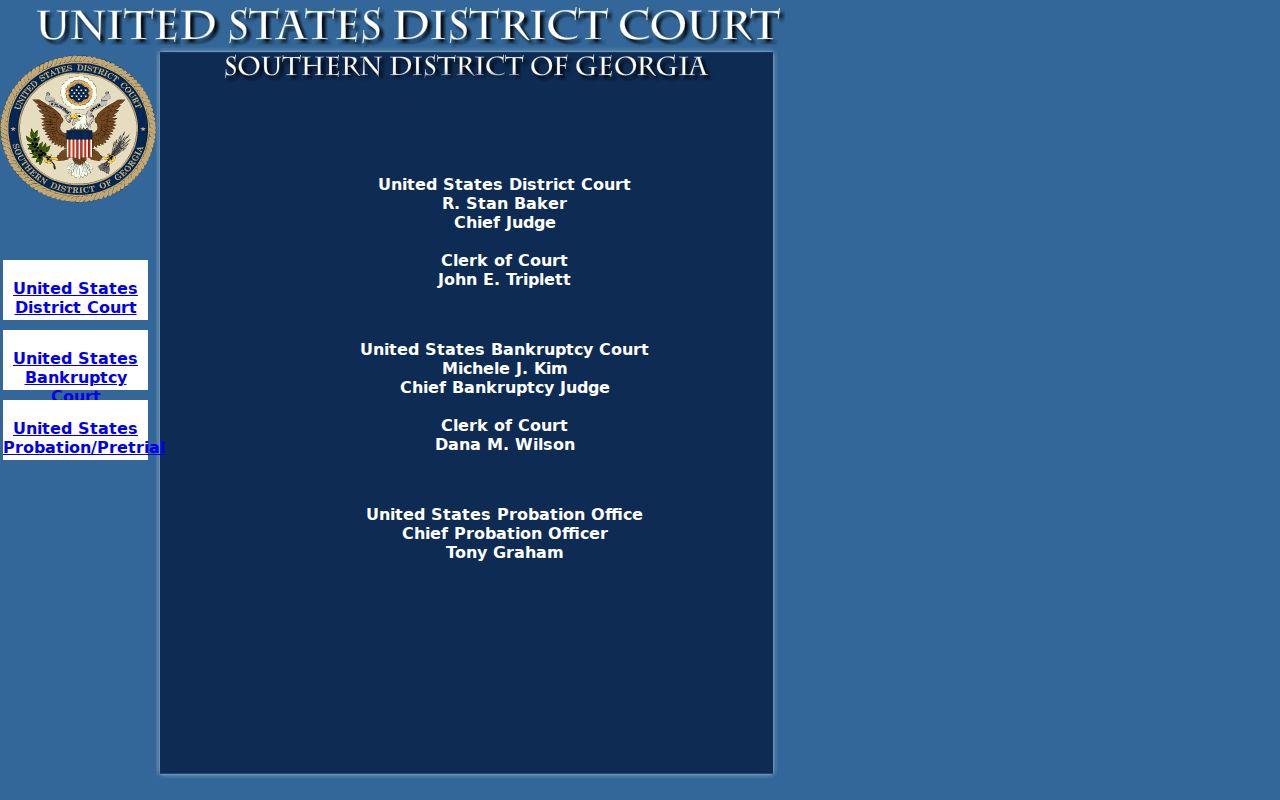
The federal court image marks a separate custodian and docket system. It should not be used as a substitute for a Tattnall County court case lookup when the charge was filed in Superior, State, Magistrate, or municipal court.
Certified Tattnall Court Records
A screen view can orient a reader, but certification serves a different purpose. The clerk’s certification attests that a copy matches the record on file. Ask for the exact judgment, sentence, charging document, or docket needed instead of requesting every page by default. This keeps the request clear and lets the clerk estimate any lawful cost.
If an online source and the clerk’s answer differ, note the search date, court, case number, and exact conflict. Ask whether the portal is delayed, the case changed courts, an event was recently filed, or an older record must be retrieved. A written or certified response is stronger than an inference drawn from a missing portal result.
Access Rules for Case Records
Georgia court records are generally open, but access has limits. Juvenile files, sealed material, protected victim information, personal identifiers, and security-sensitive content may be withheld or redacted. Uniform Superior Court Rule 21 governs access to court records and supports sealing only through the required judicial process. A missing online result therefore does not prove that no Tattnall County criminal court case exists.
The Georgia Attorney General’s open-government material explains agency record requests, but court files should be requested from their court custodian. If a document is restricted, ask the clerk what public docket information remains and whether an order controls access. Do not ask staff to disclose sealed content without lawful authority.
Access note: A docket index and its underlying documents can have different access status. Ask about each item by name.